|
In
his famous experiment, Louis Pasteur used a special flask whose neck was
shaped like an S or the neck of a swan, hence the name "Swan Neck
Flask." He put a nutrient rich broth in the flask, which he called the
"infusion." He then boiled the infusion killing any microorganisms
which were already present. Then he allowed the infusion
to sit.
Because
of the shape of the flask, the infusion was exposed to air. However, dust
particles and other things in the air never made it into the infusion.
Because they were trapped in the curve of the Swan Neck Flask. No matter how
long he allowed the flask to sit, microorganisms never appeared in the
infusion. However, if he tipped the flask and allowed the things trapped in
the neck to get into the infusion then microorgranisms began to appear in the
infusion and multiply rapidly. This demonstrates that microorganisms do not
appear as a result of Spontaneous Generation. Instead, they are introduced
into food through dust particles and other things that happen to land on the
food.
|
lunes, 1 de abril de 2013
Pasteur Swan Neck Flask Experiment
martes, 26 de febrero de 2013
Primates
Primates
Apes, monkeys, and you
The primates include the most familiar of the placental mammals, because they include us, Homo sapiens. Primates also include familiar animals, such as the chimpanzees, gorillas, and monkeys, as well as the somewhat less familiar lemurs, lorises, galagos, pottos, sifakas, indris, aye-ayes, and tarsiers.lunes, 28 de enero de 2013
The origin of life
The origin of life might seem like the ultimate cold case: no one was there
to observe it and much of the relevant evidence has been lost in the
intervening 3.5 billion years or so. Nonetheless, many separate lines of
evidence do shed light on this event, and as biologists continue to investigate
these data, they are slowly piecing together a picture of how life originated.
Major lines of evidence include DNA, biochemistry, and experiments.
Origins and DNA evidence
Biologists use the DNA sequences of modern organisms to reconstruct the tree of life and to figure out the likely characteristics of the most recent common ancestor of all living things — the "trunk" of the tree of life. In fact, according to some hypotheses, this "most recent common ancestor" may actually be a set of organisms that lived at the same time and were able to swap genes easily. In either case, reconstructing the early branches on the tree of life tells us that this ancestor (or set of ancestors) probably used DNA as its genetic material and performed complex chemical reactions. But what came before it? We know that this last common ancestor must have had ancestors of its own - a long line of forebears forming the root of the tree of life - but to learn about them, we must turn to other lines of evidence.

Origins and biochemical evidence
By studying the basic biochemistry shared by many organisms, we can begin to piece together how biochemical systems evolved near the root of the tree of life. However, up until the early 1980s, biologists were stumped by a "chicken and egg" problem: in all modern organisms, nucleic acids (DNA and RNA) are necessary to build proteins, and proteins are necessary to build nucleic acids - so which came first, the nucleic acid or the protein? This problem was solved when a new property of RNA was discovered: some kinds of RNA can catalyze chemical reactions — and that means that RNA can both store genetic information and cause the chemical reactions necessary to copy itself. This breakthrough tentatively solved the chicken and egg problem: nucleic acids (and specifically, RNA) came first — and later on, life switched to DNA-based inheritance.
The discoveries of catalytic RNA and of molecular fossils closely related to nucleic acids suggest that nucleic acids (and specifically, RNA) were crucial to Earth's first life. These observations support the RNA world hypothesis, that early life used RNA for basic cellular processes (instead of the mix of proteins, RNA, and DNA used by modern organisms).
Origins and experimental evidence
Experiments can help scientists figure out how the molecules involved in the RNA world arose. These experiments serve as "proofs of concept" for hypotheses about steps in the origin of life — in other words, if a particular chemical reaction happens in a modern lab under conditions similar to those on early Earth, the same reaction could have happened on early Earth and could have played a role in the origin of life. The 1953 Miller-Urey experiment, for example, simulated early Earth's atmosphere with nothing more than water, hydrogen, ammonia, and methane and an electrical charge standing in for lightning, and produced complex organic compounds like amino acids. Now, scientists have learned more about the environmental and atmospheric conditions on early Earth and no longer think that the conditions used by Miller and Urey were quite right. However, since Miller and Urey, many scientists have performed experiments using more accurate environmental conditions and exploring alternate scenarios for these reactions. These experiments yielded similar results - complex molecules could have formed in the conditions on early Earth.
domingo, 18 de noviembre de 2012
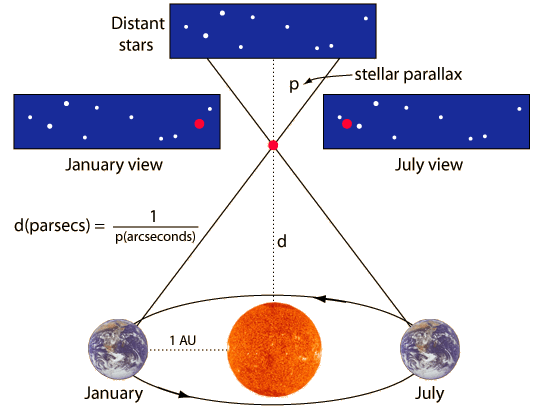
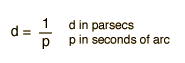
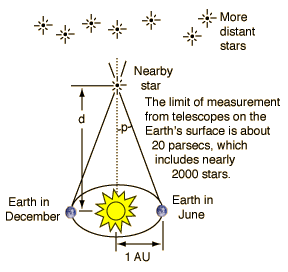
Stellar Parallax
Stellar ParallaxA nearby star's apparent movement against the background of more distant stars as the Earth revolves around the Sun is referred to as stellar parallax.![]()
|
domingo, 4 de noviembre de 2012
SCHRÖDINGER'S CAT


Schrödinger's cat is a famous illustration of the principle in quantum theory of superposition , proposed by Erwin Schrödinger in 1935. Schrödinger's cat serves to demonstrate the apparent conflict between what quantum theory tells us is true about the nature and behavior of matter on the microscopic level and what we observe to be true about the nature and behavior of matter on the macroscopic level -- everything visible to the unaided human eye.
Here's (theoretical) Schrödinger's experiment: We place a living cat into a steel chamber, along with a device containing a vial of hydrocyanic acid. There is, in the chamber, a very small amount of hydrocyanic acid, a radioactive substance. If even a single atom of the substance decays during the test period, a relay mechanism will trip a hammer, which will, in turn, break the vial and kill the cat.
The observer cannot know whether or not an atom of the substance has decayed, and consequently, cannot know whether the vial has been broken, the hydrocyanic acid released, and the cat killed. Since we cannot know, according to quantum law, the cat is both dead and alive, in what is called a superposition of states. It is only when we break open the box and learn the condition of the cat that the superposition is lost, and the cat becomes one or the other (dead or alive). This situation is sometimes called quantum indeterminacy or the observer's paradox: the observation or measurement itself affects an outcome, so that the outcome as such does not exist unless the measurement is made. (That is, there is no single outcome unless it is observed.)
We know that superposition actually occurs at the subatomic level, because there are observable effects of interference , in which a single particle is demonstrated to be in multiple locations simultaneously. What that fact implies about the nature of reality on the observable level (cats, for example, as opposed to electrons ) is one of the stickiest areas of quantum physics. Schrödinger himself is rumored to have said, later in life, that he wished he had never met that cat.
BIRTH OF THE UNIVERSE
Physics of the early Universe
is at the boundary of astronomy and philosophy since we do not currently have a
complete theory that unifies all the fundamental forces of Nature at the moment
of Creation. Our physics can explain
most of the evolution of the Universe after the Planck time (approximately 10-43 seconds after the Big Bang). Events
before the Planck time are undefined in our current science and, in particular,
we have no solid understanding of the origin of the Universe (i.e. what started
or ‘caused’ the Big Bang).

Cosmic Singularity:
One thing is clear in our
framing of questions such as ‘How did the Universe get started?’ is that the
Universe was self-creating. This is not a statement on a ‘cause’ behind the
origin of the Universe, nor is it a statement on a lack of purpose or destiny.
It is simply a statement that the Universe was emergent, that it probably
derived from an indeterminate sea of potentiality that we call the quantum
vacuum, whose properties may always remain beyond our current understanding. Extrapolation
from the present to the moment of Creation implies an origin of infinite
density and infinite temperature (all the Universe's mass and energy pushed to
a point of zero volume). Such a point is called the cosmic singularity. But the next level of inquiry
is what is the origin of the emergent properties of the Universe, the
properties that become the mass of the Universe, its age, its physical
constants, etc. The answer appears to be that these properties have their
origin as the fluctuations of the quantum vacuum. The properties of the
Universe come from ‘nothing’, where nothing is the quantum vacuum, which is a very different kind of nothing. If we
examine a piece of ‘empty’ space we see it is not truly empty, it is filled
with spacetime, for example. Spacetime has curvature and structure, and obeys
the laws of quantum physics. Thus, it is filled with potential particles, pairs
of virtual matter and anti-matter units, and potential properties at the
quantum level. The Universe is not filled by the quantum vacuum, rather it is ‘written
on’ it, the substratum of all existence.
(also black holes are
considered singularities)

Suscribirse a:
Entradas (Atom)