martes, 19 de mayo de 2020

domingo, 17 de mayo de 2020
FORM QUESTION SHEET 11th-15th May
Please, do NOT forget to write your name and course BEFORE submitting.
If you did so and your form is not graded, send it again under a different account (or post here a comment with your name and your auto-grading)
LINK TO FORM 1º Bach CULTURA CIENTÍFICA, please click here (Form 2/2)
LINK TO FORM 1ºB ESO, please click here
LINK TO FORM 3ºA-B, please click here
LINK TO FORM 4ºA/B, please click here
Please complete all the answers and then submit
(you are only allow to do it once)
If you did so and your form is not graded, send it again under a different account (or post here a comment with your name and your auto-grading)
LINK TO FORM 1º Bach CULTURA CIENTÍFICA, please click here (Form 2/2)
LINK TO FORM 1ºB ESO, please click here
LINK TO FORM 3ºA-B, please click here
LINK TO FORM 4ºA/B, please click here
Please complete all the answers and then submit
(you are only allow to do it once)
martes, 12 de mayo de 2020
Week TASKS: 11th-15th May
Some forms (formularios) will be asked to submit soon. Please, click here when ready
viernes, 8 de mayo de 2020
FORM QUESTION SHEET 4th-8th May
Please, do NOT forget to write your name and course BEFORE submitting.
If you did so and your form is not graded, send it again under a different account (or post here a comment with your name and your auto-grading)
LINK TO FORM 1ºB ESO, please click here
LINK TO FORM 3ºA-B, please click here
LINK TO FORM 4ºA/B, please click here
Please complete all the answers and then submit
(you are only allow to do it once)
If you did so and your form is not graded, send it again under a different account (or post here a comment with your name and your auto-grading)
LINK TO FORM 1ºB ESO, please click here
LINK TO FORM 3ºA-B, please click here
LINK TO FORM 4ºA/B, please click here
Please complete all the answers and then submit
(you are only allow to do it once)
lunes, 4 de mayo de 2020
Week TASKS: 4th-8th May
Some forms (formularios) will be asked to submit soon. Please, click here when ready
sábado, 2 de mayo de 2020
FORM QUESTION SHEET 27th-30th April
Please, do NOT forget to write your name and course BEFORE submitting.
If you did so and your form is not graded, send it again under a different account (or post here a comment with your name and your auto-grading)
LINK TO FORM 1º Bach CULTURA CIENTÍFICA, please click here (Form 1/2)
LINK TO FORM 1ºB ESO, please click here
LINK TO FORM 3ºA-B, please click here
LINK TO FORM 4ºA/B, please click here
Please complete all the answers and then submit
(you are only allow to do it once)
If you did so and your form is not graded, send it again under a different account (or post here a comment with your name and your auto-grading)
LINK TO FORM 1º Bach CULTURA CIENTÍFICA, please click here (Form 1/2)
LINK TO FORM 1ºB ESO, please click here
LINK TO FORM 3ºA-B, please click here
LINK TO FORM 4ºA/B, please click here
Please complete all the answers and then submit
(you are only allow to do it once)
domingo, 26 de abril de 2020
Week TASKS: 27th-30th April
Some forms (formularios) will be asked to submit soon. Please, click here when ready
miércoles, 22 de abril de 2020
FORM QUESTION SHEET 20th-24th April
Please, do NOT forget to write your name and course BEFORE submitting.
If you did so and your form is not graded, send it again under a different account (or post here a comment with your name and your auto-grading)
LINK TO FORM 1ºB ESO, please click here
LINK TO FORM 3ºA or 3ºB, please click here
LINK TO FORM 4ºA/B, please click here
Please complete all the answers and then submit
(you are only allow to do it once)
If you did so and your form is not graded, send it again under a different account (or post here a comment with your name and your auto-grading)
LINK TO FORM 1ºB ESO, please click here
LINK TO FORM 3ºA or 3ºB, please click here
LINK TO FORM 4ºA/B, please click here
Please complete all the answers and then submit
(you are only allow to do it once)
viernes, 17 de abril de 2020
Week TASKS: 20th-24th April
Some forms (formularios) will be asked to submit soon. Please, click here when ready
jueves, 2 de abril de 2020
FORM QUESTION SHEET 30th March + Easter
Please, do NOT forget to write your name and course BEFORE submitting.
If you did so and your form is not graded, send it again under a different account (or post here a comment with your name and your auto-grading)
LINK TO FORM 1ºB ESO, please click here
LINK TO FORM 3ºA or 3ºB, please click here
LINK TO FORM 4ºA/B, please click here
Please complete all the answers and then submit
(you are only allow to do it once)
If you did so and your form is not graded, send it again under a different account (or post here a comment with your name and your auto-grading)
LINK TO FORM 1ºB ESO, please click here
LINK TO FORM 3ºA or 3ºB, please click here
LINK TO FORM 4ºA/B, please click here
Please complete all the answers and then submit
(you are only allow to do it once)
sábado, 28 de marzo de 2020
domingo, 22 de marzo de 2020
FORM QUESTION SHEET 23rd-27th March
Please, do NOT forget to write your name and course when submitting
(If you did so and your form is not graded, send again under a different account)
LINK TO FORM 1ºB ESO, please click here
LINK TO FORM 3ºA or 3ºB, please click here
LINK TO FORM 4ºA/B, please click here
Please complete all the answers and then submit
(you are only allow to do it once)
(If you did so and your form is not graded, send again under a different account)
LINK TO FORM 1ºB ESO, please click here
LINK TO FORM 3ºA or 3ºB, please click here
LINK TO FORM 4ºA/B, please click here
Please complete all the answers and then submit
(you are only allow to do it once)
sábado, 14 de marzo de 2020
jueves, 12 de marzo de 2020
Department of Biología y Geología (Week 16th to 20th TASKS)
(Only for bilingual Science students)
As a result of the Resolución sobre Instrucciones de Funcionamiento
de los centros educativos afectados por las medidas adoptadas como
consecuencia del COVID-19 (Comunidad de Madrid), next we detail the
student plan for the days the classroom teaching educational activities
have been suspended.
1º B ESO
Monday the 16th:
Please, pass neat the animal evolution diagram in the notebook
Make a drawing of virus and bacteria and mark the differences
Summarize the algae and fungi kingdoms characteristics and write the types
Wendsday the 18th:
Make a chart of classification of plants (please, disregard the liverworts)
Draw the stem, leaf and root morphology (pag 48, 49 & 51)
Make a diagram of stomata (pag 50) and explain the opening and closing mechanism (search the
net for further information)
Thursday the 19th:
Please, draw a picture of a flower and a fruit
Summarize the sexual reproduction in plants
Read “Plant and us” (pag 58 & 59)
3ºA ESO
Monday the 16th:
Please, read the anatomy of the eye and ear (pag 30,32)
Summarize how the eye and ear work
Please search the net for actual information about sensitive areas of the tongue
3ºA&B ESO
Wednesday the 18th:
See monday
Please, disregard for the time being the effectors
Read illnesses of the locomotor system (pag 43)
3ºB ESO
Thursday the 19th:
Read the changes during human reproductive life (pag 51)
Try to learn the anatomy of male and female reproductive system
Do not pay special attention to gametogenesis. Go deep (important) into ovarian and uterine cycle
3ºA&B ESO
Friday th 20th:
See thursday
Read gestation and birth (pag 58, 59)
Summarize contraceptive methods (natural and artificial)
4º ESO
Read and summarize the mechanisms of evolution and human evolution (important)
Start reading and preparing Unit 7. The origin of the Earth
See the blog for further instructions
1º BACH
See the blog Unit 5 about Genetics
Search information about virus, bacteria and vaccines
(Only for bilingual Science students)
As a result of the Resolución sobre Instrucciones de Funcionamiento
de los centros educativos afectados por las medidas adoptadas como
consecuencia del COVID-19 (Comunidad de Madrid), next we detail the
student plan for the days the classroom teaching educational activities
have been suspended.
1º B ESO
Monday the 16th:
Please, pass neat the animal evolution diagram in the notebook
Make a drawing of virus and bacteria and mark the differences
Summarize the algae and fungi kingdoms characteristics and write the types
Wendsday the 18th:
Make a chart of classification of plants (please, disregard the liverworts)
Draw the stem, leaf and root morphology (pag 48, 49 & 51)
Make a diagram of stomata (pag 50) and explain the opening and closing mechanism (search the
net for further information)
Thursday the 19th:
Please, draw a picture of a flower and a fruit
Summarize the sexual reproduction in plants
Read “Plant and us” (pag 58 & 59)
3ºA ESO
Monday the 16th:
Please, read the anatomy of the eye and ear (pag 30,32)
Summarize how the eye and ear work
Please search the net for actual information about sensitive areas of the tongue
3ºA&B ESO
Wednesday the 18th:
See monday
Please, disregard for the time being the effectors
Read illnesses of the locomotor system (pag 43)
3ºB ESO
Thursday the 19th:
Read the changes during human reproductive life (pag 51)
Try to learn the anatomy of male and female reproductive system
Do not pay special attention to gametogenesis. Go deep (important) into ovarian and uterine cycle
3ºA&B ESO
Friday th 20th:
See thursday
Read gestation and birth (pag 58, 59)
Summarize contraceptive methods (natural and artificial)
4º ESO
Read and summarize the mechanisms of evolution and human evolution (important)
Start reading and preparing Unit 7. The origin of the Earth
See the blog for further instructions
1º BACH
See the blog Unit 5 about Genetics
Search information about virus, bacteria and vaccines
jueves, 21 de diciembre de 2017


jueves, 5 de octubre de 2017
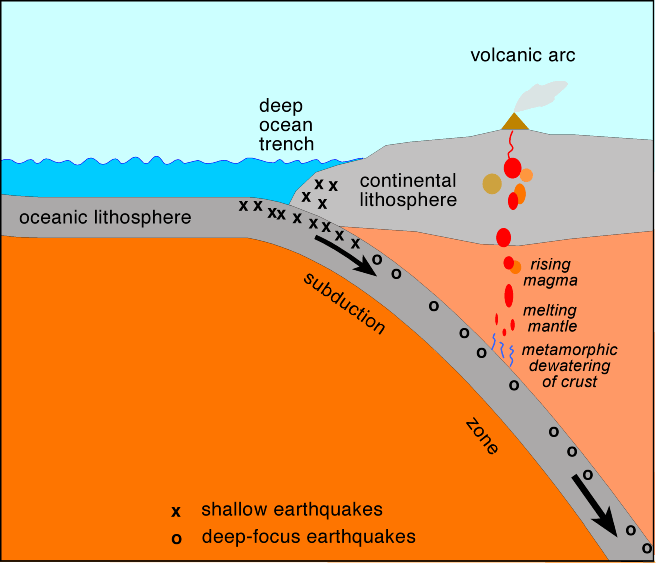
¿Por qué funden las rocas en las zonas de subducción?
Where two tectonic plates converge, if one or both of the plates is oceanic lithosphere, a subduction zone will form. An oceanic plate will sink back into the mantle. Remember, oceanic plates are formed from mantle material at midocean ridges. Young oceanic lithosphere is hot and buoyant (low density) when it forms at a midocean ridge. But as it spreads away from the ridge and cools and contracts (becomse denser) it is able to sink into the hotter underlying mantle. There is a deep ocean trench where the oceanic plate bends downward.
Volcanic Arcs: The basaltic ocean crust contains hydrous minerals like amphiboles, some of which formed by hydrothermal alteration as seawater seeped through hot, fractured, young ocean crust at the midocean ridge. As the ocean crust sinks deeper into the mantle the pressure increases (the temperature of the ocean crust rocks increases more slowly because rocks are poor conductors of heat). At depths of around 100 km beneath the surface, the pressure is great enough for the hydrous minerals to undergo metamorphism. The resulting minerals are denser and they don't contain the bonded water. This metamorphic dewatering process liberates water from the descending crust. The water gradually seeps upward into the overlying wedge of hot mantle. The addition of water to the already hot mantle rocks lowers their melting temperature resulting in partial melting of ultramafic mantle rocks to yield mafic magma. Melting aided by the addition of water or other fluid is called flux melting. It is somewhat more complicated than this, but metamorphic dewatering of suducting crust and flux melting of the mantle wedge appears to account for most of the magma at subduction zones.
Magma formed above a subducting plate slowly rise into the overriding crust and finally to the surface forming a volcanic arc, a chain of active volcanoes which parallels the deep ocean trench. Beneath the active volcanic arc lie intrusive igneous rocks formed from magma that didn't make it all the way to the surface before crystallizing. The volcanic arcs may be volcanic island arcs(e.g., Aleutians, Mariannas), where one oceanic plate subducts beneath another oceanic plate, or continental volcanic arcs (e.g., Andes, Cascades), where oceanic plates subduct under a continental plate. The most abundant igneous rock formed at volcanic arcs is andesite (or intrusive diorite), though volcanic arc rocks may range in composition from basalt to rhyolite (mafic to felsic)

domingo, 19 de marzo de 2017

martes, 28 de febrero de 2017
https://play.kahoot.it/#/
 https://play.kahoot.it/#/k/561a4aa2-62ed-423b-8e90-40d7764930dek/561a4aa2-62ed-423b-8e90-40d7764930de

martes, 14 de febrero de 2017
Suscribirse a:
Entradas (Atom)