sábado, 28 de marzo de 2020

domingo, 22 de marzo de 2020
FORM QUESTION SHEET 23rd-27th March
Please, do NOT forget to write your name and course when submitting
(If you did so and your form is not graded, send again under a different account)
LINK TO FORM 1ºB ESO, please click here
LINK TO FORM 3ºA or 3ºB, please click here
LINK TO FORM 4ºA/B, please click here
Please complete all the answers and then submit
(you are only allow to do it once)
(If you did so and your form is not graded, send again under a different account)
LINK TO FORM 1ºB ESO, please click here
LINK TO FORM 3ºA or 3ºB, please click here
LINK TO FORM 4ºA/B, please click here
Please complete all the answers and then submit
(you are only allow to do it once)
sábado, 14 de marzo de 2020
jueves, 12 de marzo de 2020
Department of Biología y Geología (Week 16th to 20th TASKS)
(Only for bilingual Science students)
As a result of the Resolución sobre Instrucciones de Funcionamiento
de los centros educativos afectados por las medidas adoptadas como
consecuencia del COVID-19 (Comunidad de Madrid), next we detail the
student plan for the days the classroom teaching educational activities
have been suspended.
1º B ESO
Monday the 16th:
Please, pass neat the animal evolution diagram in the notebook
Make a drawing of virus and bacteria and mark the differences
Summarize the algae and fungi kingdoms characteristics and write the types
Wendsday the 18th:
Make a chart of classification of plants (please, disregard the liverworts)
Draw the stem, leaf and root morphology (pag 48, 49 & 51)
Make a diagram of stomata (pag 50) and explain the opening and closing mechanism (search the
net for further information)
Thursday the 19th:
Please, draw a picture of a flower and a fruit
Summarize the sexual reproduction in plants
Read “Plant and us” (pag 58 & 59)
3ºA ESO
Monday the 16th:
Please, read the anatomy of the eye and ear (pag 30,32)
Summarize how the eye and ear work
Please search the net for actual information about sensitive areas of the tongue
3ºA&B ESO
Wednesday the 18th:
See monday
Please, disregard for the time being the effectors
Read illnesses of the locomotor system (pag 43)
3ºB ESO
Thursday the 19th:
Read the changes during human reproductive life (pag 51)
Try to learn the anatomy of male and female reproductive system
Do not pay special attention to gametogenesis. Go deep (important) into ovarian and uterine cycle
3ºA&B ESO
Friday th 20th:
See thursday
Read gestation and birth (pag 58, 59)
Summarize contraceptive methods (natural and artificial)
4º ESO
Read and summarize the mechanisms of evolution and human evolution (important)
Start reading and preparing Unit 7. The origin of the Earth
See the blog for further instructions
1º BACH
See the blog Unit 5 about Genetics
Search information about virus, bacteria and vaccines
(Only for bilingual Science students)
As a result of the Resolución sobre Instrucciones de Funcionamiento
de los centros educativos afectados por las medidas adoptadas como
consecuencia del COVID-19 (Comunidad de Madrid), next we detail the
student plan for the days the classroom teaching educational activities
have been suspended.
1º B ESO
Monday the 16th:
Please, pass neat the animal evolution diagram in the notebook
Make a drawing of virus and bacteria and mark the differences
Summarize the algae and fungi kingdoms characteristics and write the types
Wendsday the 18th:
Make a chart of classification of plants (please, disregard the liverworts)
Draw the stem, leaf and root morphology (pag 48, 49 & 51)
Make a diagram of stomata (pag 50) and explain the opening and closing mechanism (search the
net for further information)
Thursday the 19th:
Please, draw a picture of a flower and a fruit
Summarize the sexual reproduction in plants
Read “Plant and us” (pag 58 & 59)
3ºA ESO
Monday the 16th:
Please, read the anatomy of the eye and ear (pag 30,32)
Summarize how the eye and ear work
Please search the net for actual information about sensitive areas of the tongue
3ºA&B ESO
Wednesday the 18th:
See monday
Please, disregard for the time being the effectors
Read illnesses of the locomotor system (pag 43)
3ºB ESO
Thursday the 19th:
Read the changes during human reproductive life (pag 51)
Try to learn the anatomy of male and female reproductive system
Do not pay special attention to gametogenesis. Go deep (important) into ovarian and uterine cycle
3ºA&B ESO
Friday th 20th:
See thursday
Read gestation and birth (pag 58, 59)
Summarize contraceptive methods (natural and artificial)
4º ESO
Read and summarize the mechanisms of evolution and human evolution (important)
Start reading and preparing Unit 7. The origin of the Earth
See the blog for further instructions
1º BACH
See the blog Unit 5 about Genetics
Search information about virus, bacteria and vaccines
jueves, 21 de diciembre de 2017


jueves, 5 de octubre de 2017
¿Por qué funden las rocas en las zonas de subducción?
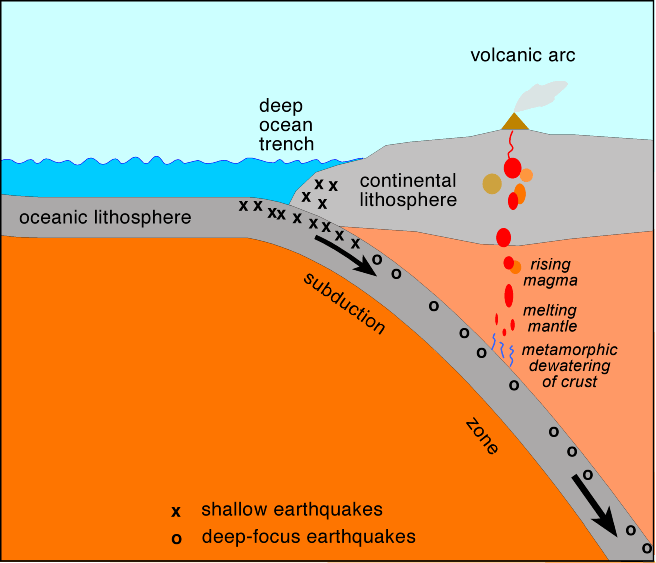
Where two tectonic plates converge, if one or both of the plates is oceanic lithosphere, a subduction zone will form. An oceanic plate will sink back into the mantle. Remember, oceanic plates are formed from mantle material at midocean ridges. Young oceanic lithosphere is hot and buoyant (low density) when it forms at a midocean ridge. But as it spreads away from the ridge and cools and contracts (becomse denser) it is able to sink into the hotter underlying mantle. There is a deep ocean trench where the oceanic plate bends downward.
Volcanic Arcs: The basaltic ocean crust contains hydrous minerals like amphiboles, some of which formed by hydrothermal alteration as seawater seeped through hot, fractured, young ocean crust at the midocean ridge. As the ocean crust sinks deeper into the mantle the pressure increases (the temperature of the ocean crust rocks increases more slowly because rocks are poor conductors of heat). At depths of around 100 km beneath the surface, the pressure is great enough for the hydrous minerals to undergo metamorphism. The resulting minerals are denser and they don't contain the bonded water. This metamorphic dewatering process liberates water from the descending crust. The water gradually seeps upward into the overlying wedge of hot mantle. The addition of water to the already hot mantle rocks lowers their melting temperature resulting in partial melting of ultramafic mantle rocks to yield mafic magma. Melting aided by the addition of water or other fluid is called flux melting. It is somewhat more complicated than this, but metamorphic dewatering of suducting crust and flux melting of the mantle wedge appears to account for most of the magma at subduction zones.
Magma formed above a subducting plate slowly rise into the overriding crust and finally to the surface forming a volcanic arc, a chain of active volcanoes which parallels the deep ocean trench. Beneath the active volcanic arc lie intrusive igneous rocks formed from magma that didn't make it all the way to the surface before crystallizing. The volcanic arcs may be volcanic island arcs(e.g., Aleutians, Mariannas), where one oceanic plate subducts beneath another oceanic plate, or continental volcanic arcs (e.g., Andes, Cascades), where oceanic plates subduct under a continental plate. The most abundant igneous rock formed at volcanic arcs is andesite (or intrusive diorite), though volcanic arc rocks may range in composition from basalt to rhyolite (mafic to felsic)

domingo, 19 de marzo de 2017

martes, 28 de febrero de 2017
https://play.kahoot.it/#/
 https://play.kahoot.it/#/k/561a4aa2-62ed-423b-8e90-40d7764930dek/561a4aa2-62ed-423b-8e90-40d7764930de

martes, 14 de febrero de 2017
martes, 31 de enero de 2017
sábado, 21 de enero de 2017
Descubren el pozo vertical más grande de España
Esta cueva localizada en Cantabria, de 435 metros de profundidad, entraría en la lista de los diez pozos verticales más profundos del mundo

Un grupo de espeleólogos cántabros ha descubierto y explorado el que, según aseguran, es el mayor pozo vertical de España y uno de los primeros del mundo, con una profundidad de 435,92 metros y situado en la ladera de Porracolina, en la vertiente del valle de Calseca, en Ruesga.
miércoles, 4 de noviembre de 2015

jueves, 22 de octubre de 2015


lunes, 19 de octubre de 2015
jueves, 3 de abril de 2014


miércoles, 2 de abril de 2014
SPANISH FLU
1918 flu pandemic

Soldiers from Fort Riley,
Kansas,
ill with Spanish influenza at a
hospital ward at Camp Funston.
Most influenza outbreaks disproportionately kill juvenile, elderly, or already weakened patients; in contrast the 1918 pandemic killed predominantly previously healthy young adults. Modern research, using virus taken from the bodies of frozen victims, has concluded that the virus kills through a cytokine storm (overreaction of the body's immune system). The strong immune reactions of young adults ravaged the body, whereas the weaker immune systems of children and middle-aged adults resulted in fewer deaths among those groups.
Historical and epidemiological data are inadequate to identify the pandemic's geographic origin. It was implicated in the outbreak of encephalitis lethargica in the 1920s.
To maintain morale, wartime censors minimized early reports of illness and mortality in Germany, Britain, France, and the United States; but papers were free to report the epidemic's effects in neutral Spain (such as the grave illness of King Alfonso XIII), creating a false impression of Spain as especially hard hit—thus the pandemic's nickname Spanish flu.
miércoles, 19 de febrero de 2014
Penfield's homúnculo

The Canadian neurologist Wilder Penfield discovered this little person in the 1930s, when he opened up the skulls of his patients to perform brain surgery. He would sometimes apply a little electric jolt to different spots on the surface of the brain and ask his patients–still conscious–to tell him if they felt anything. Sometimes their tongues tingled. Other times their hand twitched. Penfield drew a map of these responses. He ended up with a surreal portrait of the human body stretched out across the surface of the brain. In a 1950 book, he offered a map of this so-called homunculus.


Phantom Limb (Sensorimotor Homunculus in Panton Phantom Chair), 2011
Sensorimotor Homunculus is a pictorial representation of the anatomical divisions of the portion of the human brain directly responsible for the movement and exchange of sense and motor information of the rest of the body. It gives us an image of how our brain and our body is connected. The 3D model relates to Wilder Penfield's diagram, where the individual body parts are drawn lying across the surface of the brain. This diagram offers an explanation to why some people sense amputated or missing limbs, as short circuits in neighbouring areas of the brain can give the sensation of a phantom limb. Verner Panton's Phantom Chair represents an amorpheous body, which in this image is represented by the fleshy colour, a reference to the brain or an amputated body or a tongue.

viernes, 24 de mayo de 2013
Induced pluripotent stem cells, commonly abbreviated as iPS cells or iPSCs are a type of pluripotent stem cell artificially derived from a non-pluripotent cell, typically an adult somatic cell, by inducing a "forced" expression of certain genes and transcription factors.These transcription factors play a key role in determining the state of these cells and also highlights the fact that these somatic cells do preserve the same genetic information as early embryonic cells.The ability to induce cells into a pluripotent state was initially pioneered using mouse fibroblasts and four transcription factors, Oct4, Sox2, Klf4 and c-Myc, in 2006.This was then followed in 2007 by the successful induction of human iPSCs derived from human dermal fibroblasts using methods similar to those used for the induction of mouse cells. These induced cells exhibit similar traits to those of embryonic stem cells (ESCs) but do not require the use of embryos. Some of the similarities between ESCs and iPSCs include pluripotency,morphology, self-renewal ability, a trait that implies that they can divide and replicate indefinitely, and gene expression.


Suscribirse a:
Entradas (Atom)